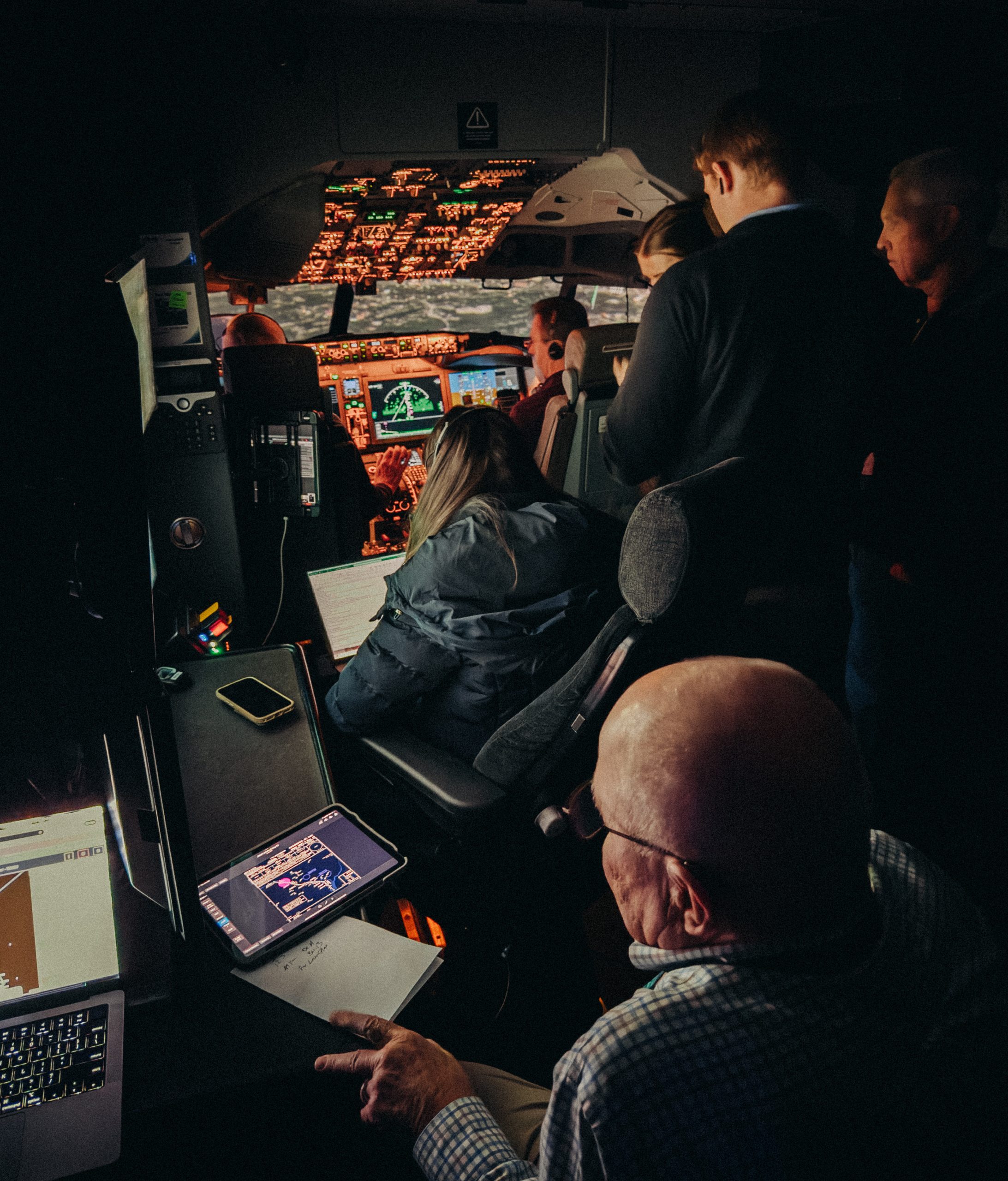
Simulated Air Traffic Control Environments (SATCE) is an aviation training technology used in flight simulators to realistically replicate the presence of other aircraft (both out the window and on flight deck instruments) and live air traffic control interactions on the appropriate radios. In practice, SATCE systems generate virtual traffic on the ground and in the air while providing synthetic ATC radio and data communications to both the “ownship” aircraft and surrounding traffic, creating a full operational environment instead of the otherwise “sterile” flight deck. This allows pilots to practice standardized phraseology, manage complex, high-workload scenarios, and experience realistic traffic patterns and conflicts without requiring instructors to role-play ATC or other aircraft.
The FAA, EASA, ICAO and other industry groups view SATCE as an important evolution in flight simulation because it enhances training fidelity, helps address communication-related safety risks, and supports more robust, scenario-based training for both civil and military aviation. The updated ARINC Specification 439, “Guidance for Simulated Air Traffic Control Environments in Flight Simulation Training Devices,” is expected to serve as the industry’s primary reference for adopting and implementing SATCE, while also informing regulatory standards development by the FAA and ICAO for simulator qualification.
ASTi, with its SATCE solution SERA (Simulated Environment for Realistic ATC), was selected to participate in a Cooperative Research and Development Agreement (CRADA) with the FAA under the National Aviation Research Plan (NARP) for 2024–2028. The effort supports development of a certification pathway for simulated air traffic control (ATC) environments. This work is part of an 18-month effort to evaluate and update recommendations for the use of simulated ATC in flight training devices.
Phase I of the study implemented SERA on simulation platforms at the FAA William J. Hughes Technical Center for Advanced Aerospace. Phase II transitioned to an FAA Level-D Boeing 737 full-flight simulator. Phase II-A, conducted in February 2026, and Phase II-B, conducted in April 2026, together included a total of 26 Alaska Airlines pilots forming 13 crews. The objective was to evaluate whether SATCE enhances training effectiveness without reducing performance, identify operational benefits and limitations, and inform both industry and FAA decisions on cost-benefit considerations for implementation.
Each crew completed four training scenarios: Line-Oriented Flight Training (LOFT) with SATCE, LOFT without SATCE, Special Purpose Operational Training (SPOT) with SATCE, and SPOT without SATCE. Across the study, researchers collected nearly 50 hours of post-scenario pilot interviews, supplemented by observational and subjective data gathered during the simulation sessions.
Related Posts
Visual Dominance
Enhanced Helicopter Vision Systems (EHVS)